
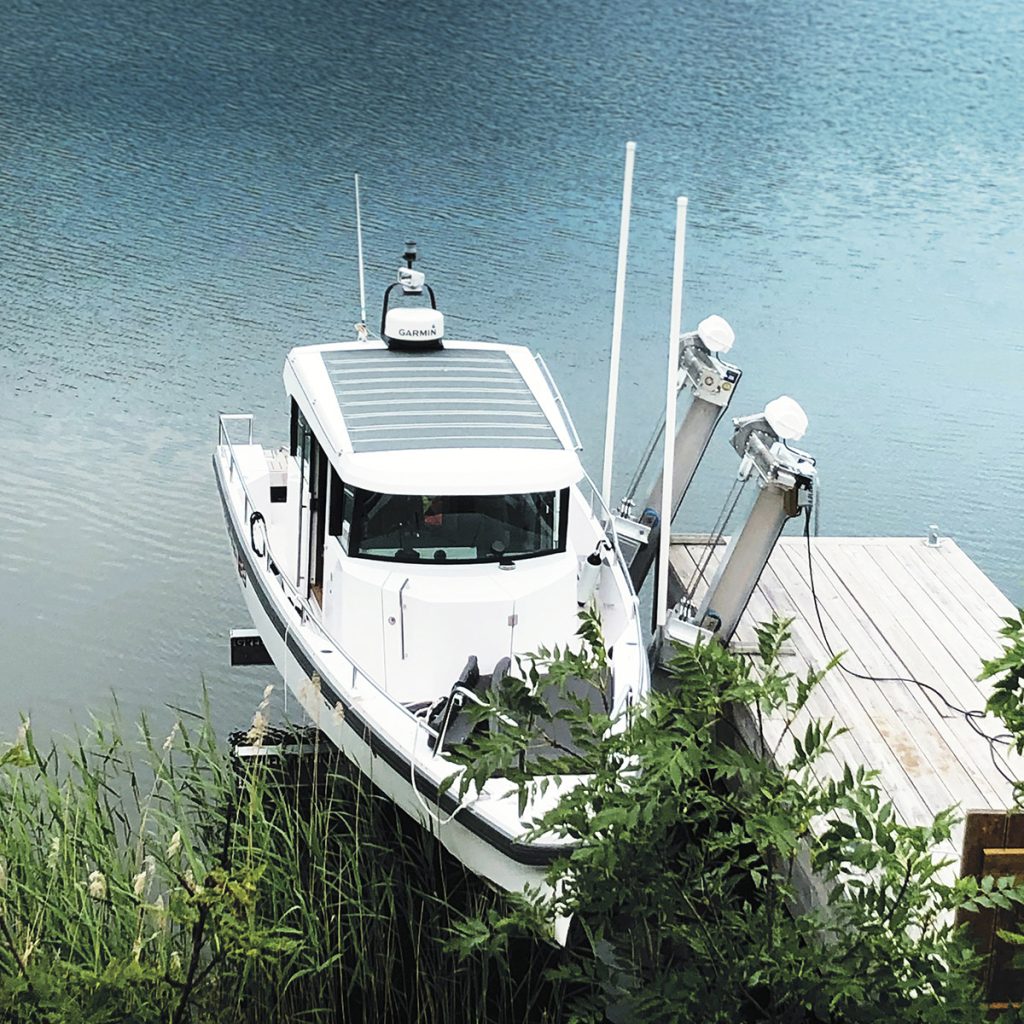
How to choose the right boat lift — step by step
To choose the right boat lift you need five inputs: the boat’s weight with equipment and full tanks, water depth at the dock at normal and low water, the bottom composition, dock stability, and whether power is available. A piling lift requires at least 2 metres of clay or sand, a hydraulic lift needs an even bottom, and a freestanding lift copes with uneven bottom via adjustable legs.
- Over 1,000 installations since 2004
- Lifts from 640 kg to 54 tonnes
- Installations across Sweden and the Nordics
- Warranty on every lift
How the choice is made
Choosing a boat lift comes down to five measurements. With those in hand, the rest is quick and you get a proposal that holds up in reality.
Weigh the boat correctly
Boat weight including motor, equipment and full tanks — pick capacity with margin, not right at the limit.
Measure water depth at the dock
Both at normal water and low water, since depth determines which models are possible.
Find out what the bottom is made of
A piling lift requires at least 2 m of clay or sand, a hydraulic lift wants an even bottom, and a freestanding lift copes with unevenness.
Assess dock stability
A stable fixed dock, quay or rock wall carries a dock lift. If the dock is weak or floating, a piling or freestanding lift is the right way.
Power or solar
Check if power is available; otherwise there are 12 V and 24 V motors with solar charging.
Choose model and profile
Low profile for discreet installation, high profile in shallower water, and an ice bubbler if the lift stays through winter.
Pre-quote checklist
Need help choosing the right lift?
Tell us about your boat and dock — we help you find the right model and capacity.
Send request